Ghady Sader

Mechanical engineering, UC Berkeley and the American University of Beirut

Ghady Sader

These are five engineering projects from my degree, with the test results and competition rankings for each.

GPA above 4.0
Dean's Honor List every semester
Full Merit Scholarship
1 of 10 awarded among 6,400+ applicants to AUB in 2024
Founder, AUB Honor Society
1,877 scholars, the largest student society in AUB's history
VMT GmbH, Herrenknecht Group
Automation and navigation systems intern, Germany

Selected work

Five machines and studies, 2025 to 2026

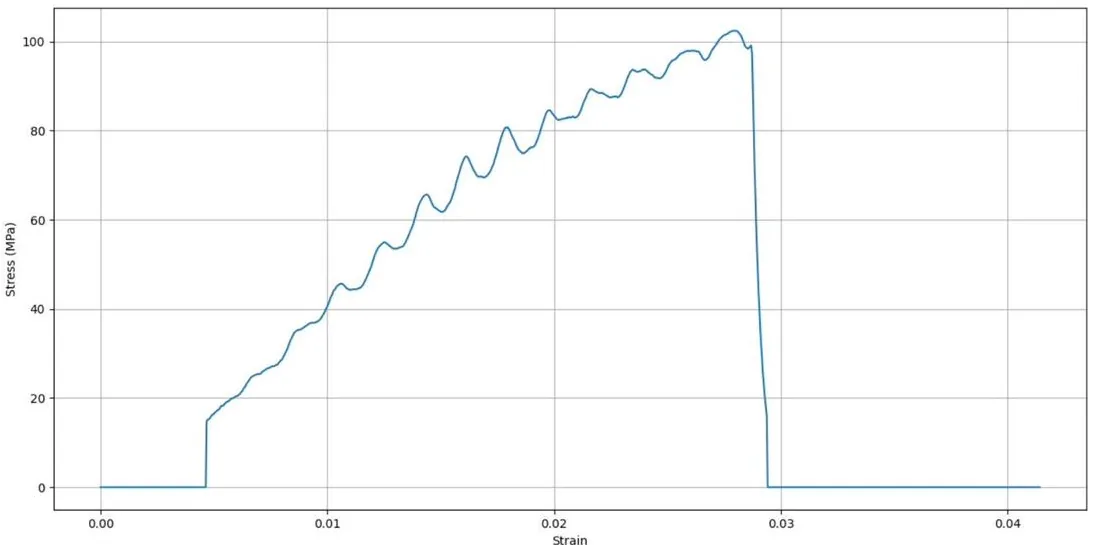
Best Project Award Stress-strain curve recorded by the machine, rising to about 100 MPa before fracture

Best Project AwardRank 1 among AUB mechanical engineering students

3-point bending test machine

A working materials tester built for $130. I led a team of four on the 3D-printed frame, the stepper-motor drive and the Python software that runs a test and plots it live.

$130
total build cost
Rank 1
among AUB mechanical engineering students
Python
motor control and live data
Read the case study
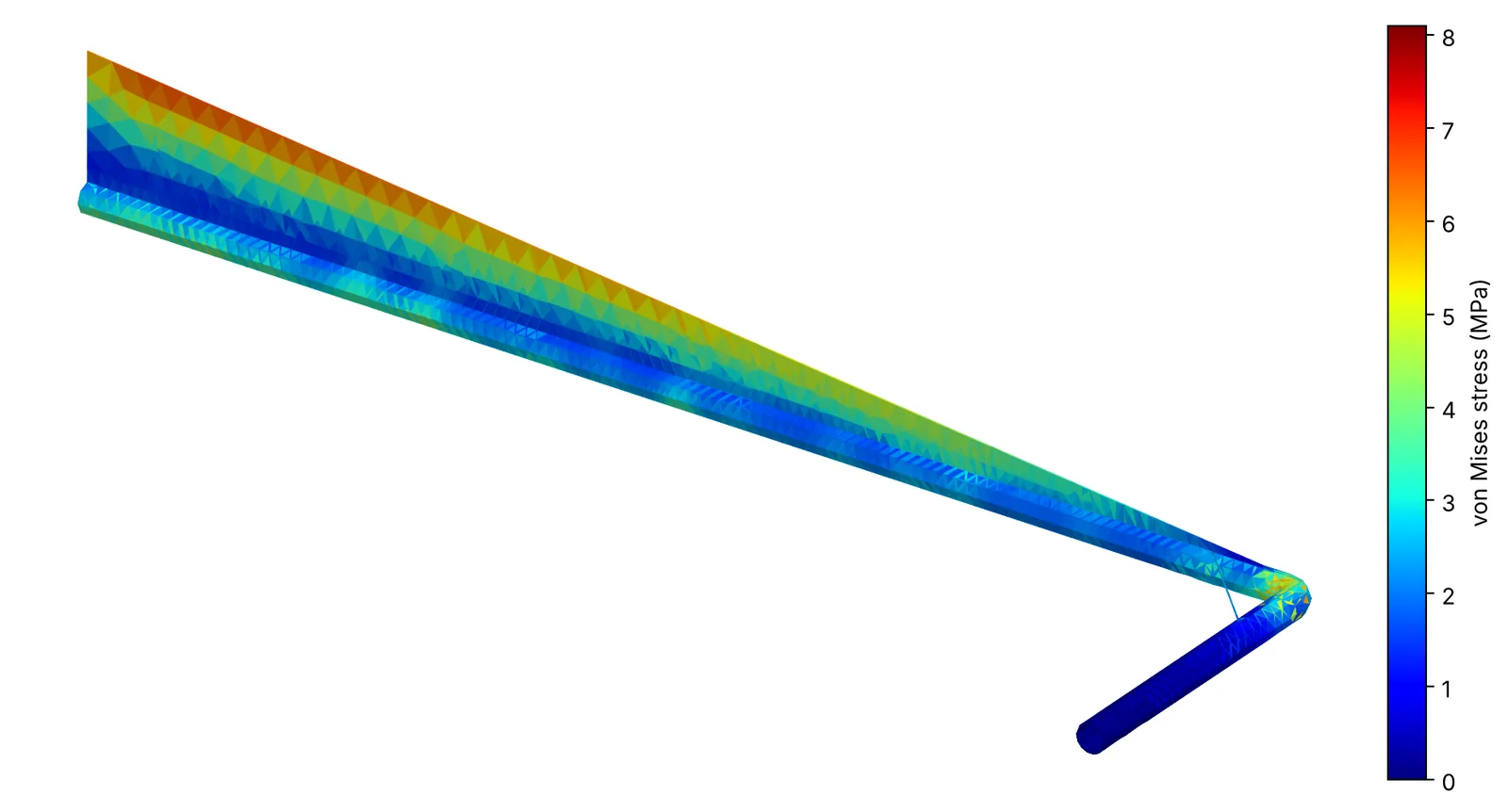
1st placeVon Mises stress plot of the final pipe design with its tapered web

1st placeFEA Structural Optimization Competition, ranked first among all AUB teams

FEA-optimized steel pipe

A thin-walled cantilever pipe that had to be light, stiff and lightly stressed at once. Forty-nine simulation runs turned a sagging rectangular duct into the winning design.

10.17 → 5.18
competition score, lower wins
−90%
outlet deflection
−85%
peak stress
Read the case study
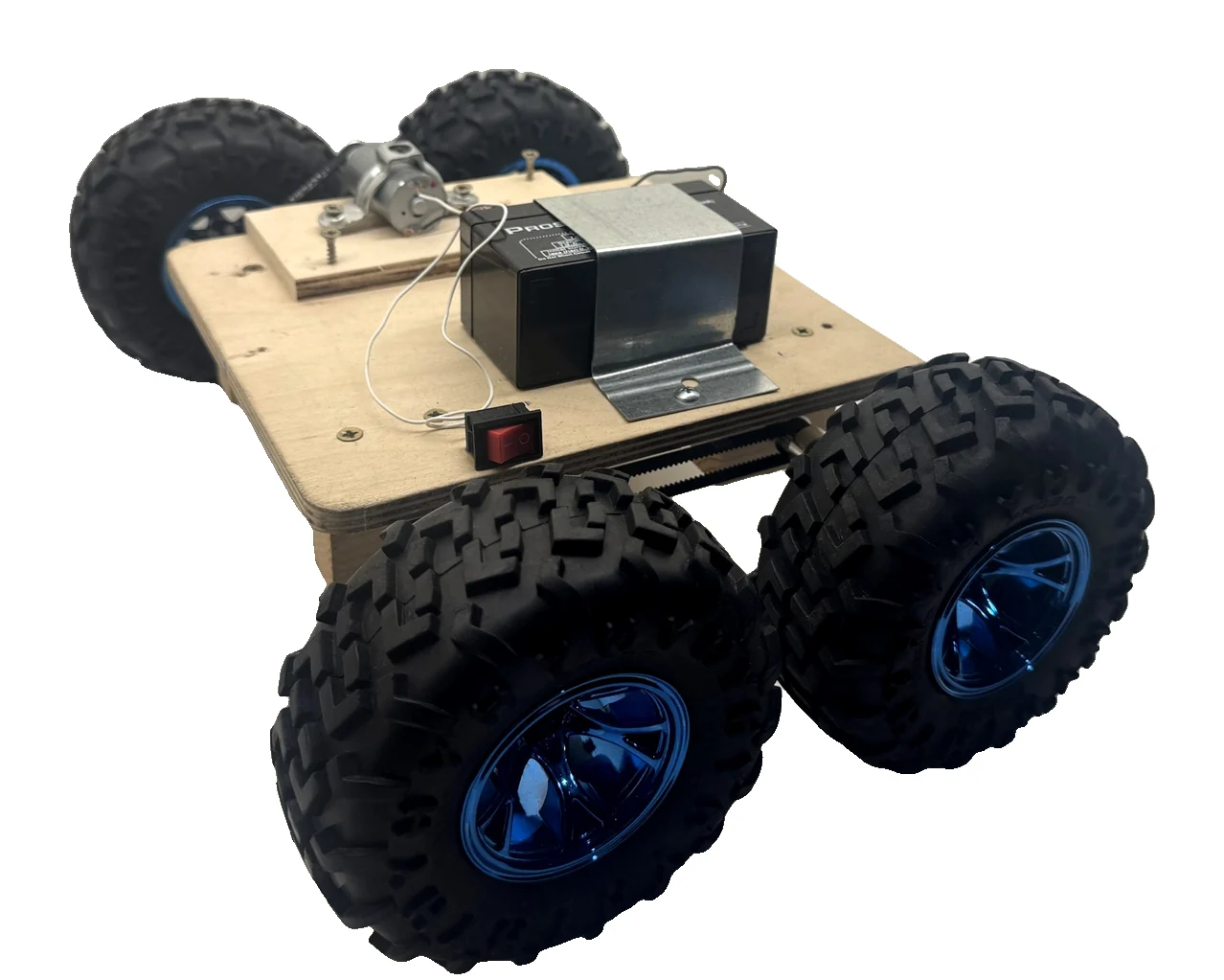
2nd place The four-wheel-drive micro-car with its motor, battery and off-road tires

2nd placeMicro-Car Competition, among AUB mechanical engineering teams

Off-road micro-car

A four-wheel-drive car driven by a single motor through two belts. I led the design and manufacturing with a team of four for a contest of a sprint, an obstacle course, a 30° ramp climb and a tug of war.

4WD
from a single motor
3:1
belt reduction
4 events
sprint, obstacles, ramp, tug of war
Read the case study
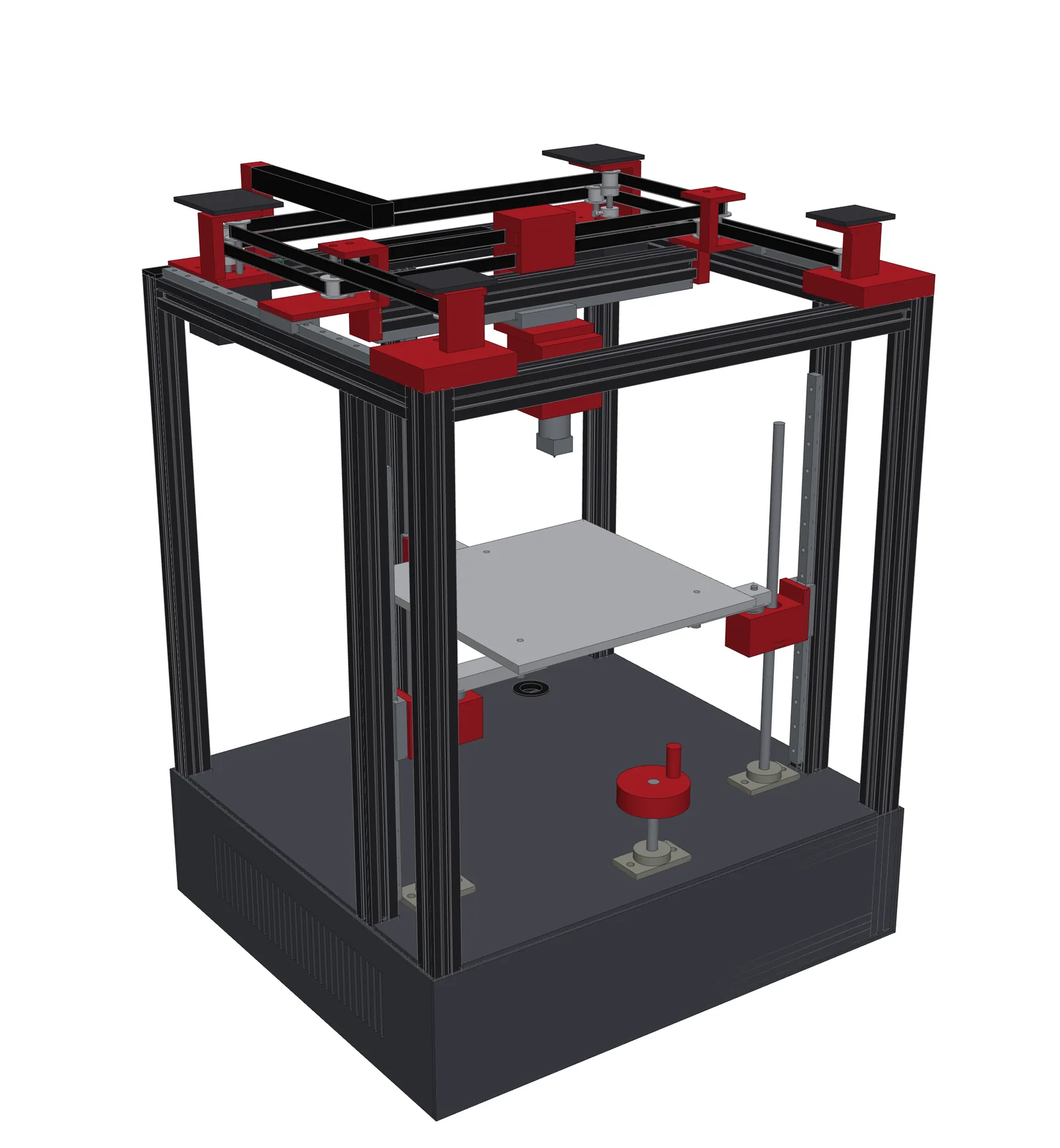
CAD model of the CoreXY printer frame, gantry, bed and electronics bay
Design frozen, competition in December 2026

CoreXY desktop 3D printer

The full mechanical hardware of a printer. We chose the architecture from four concepts, then checked the design with FEA and fatigue analysis, which led to two design changes.

52.1 → 24.6 µm
X-beam deflection at the nozzle
20,000
Monte Carlo trials on the concept choice
1.74 → 2.66
shaft fatigue safety factor
Read the case study
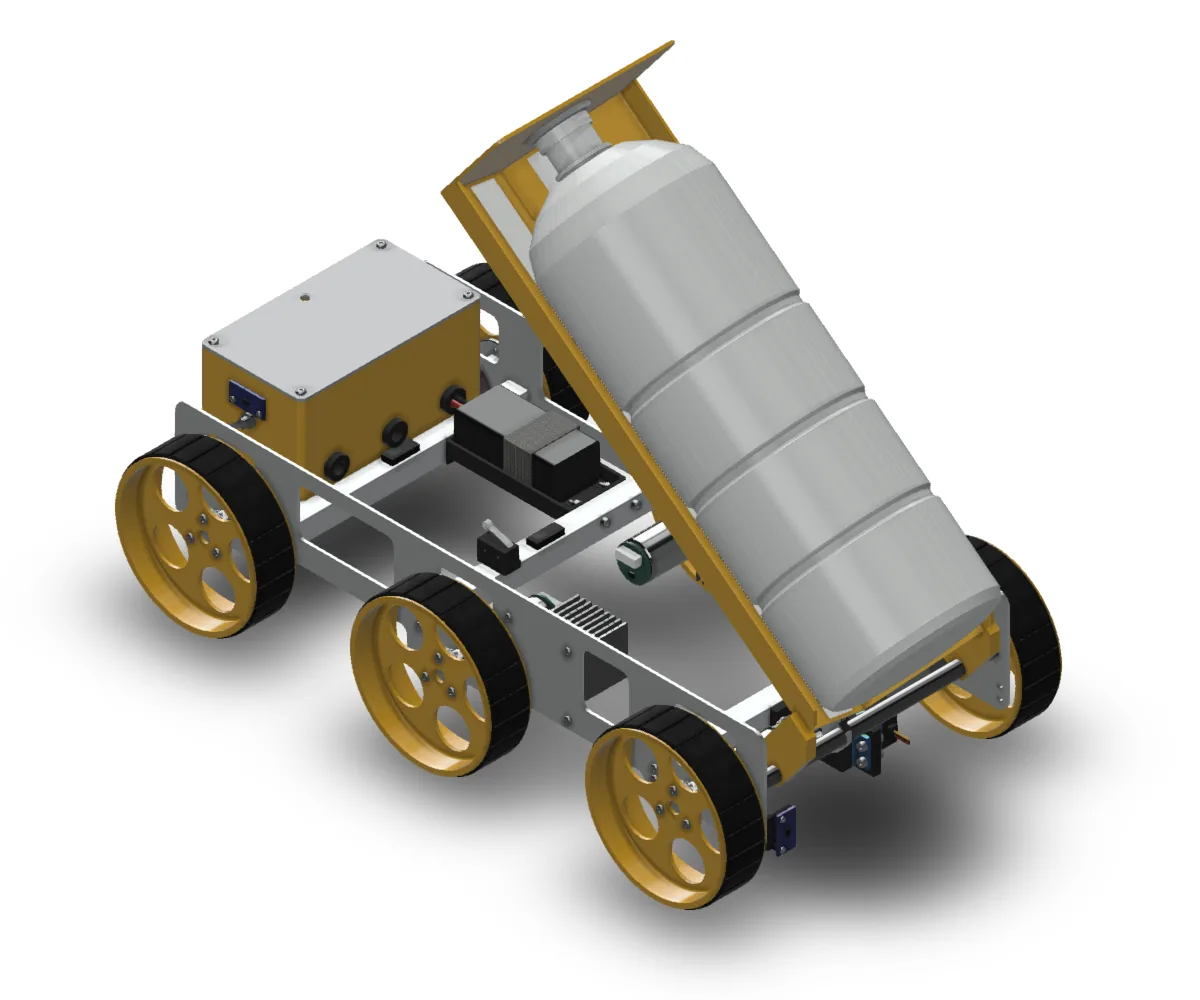
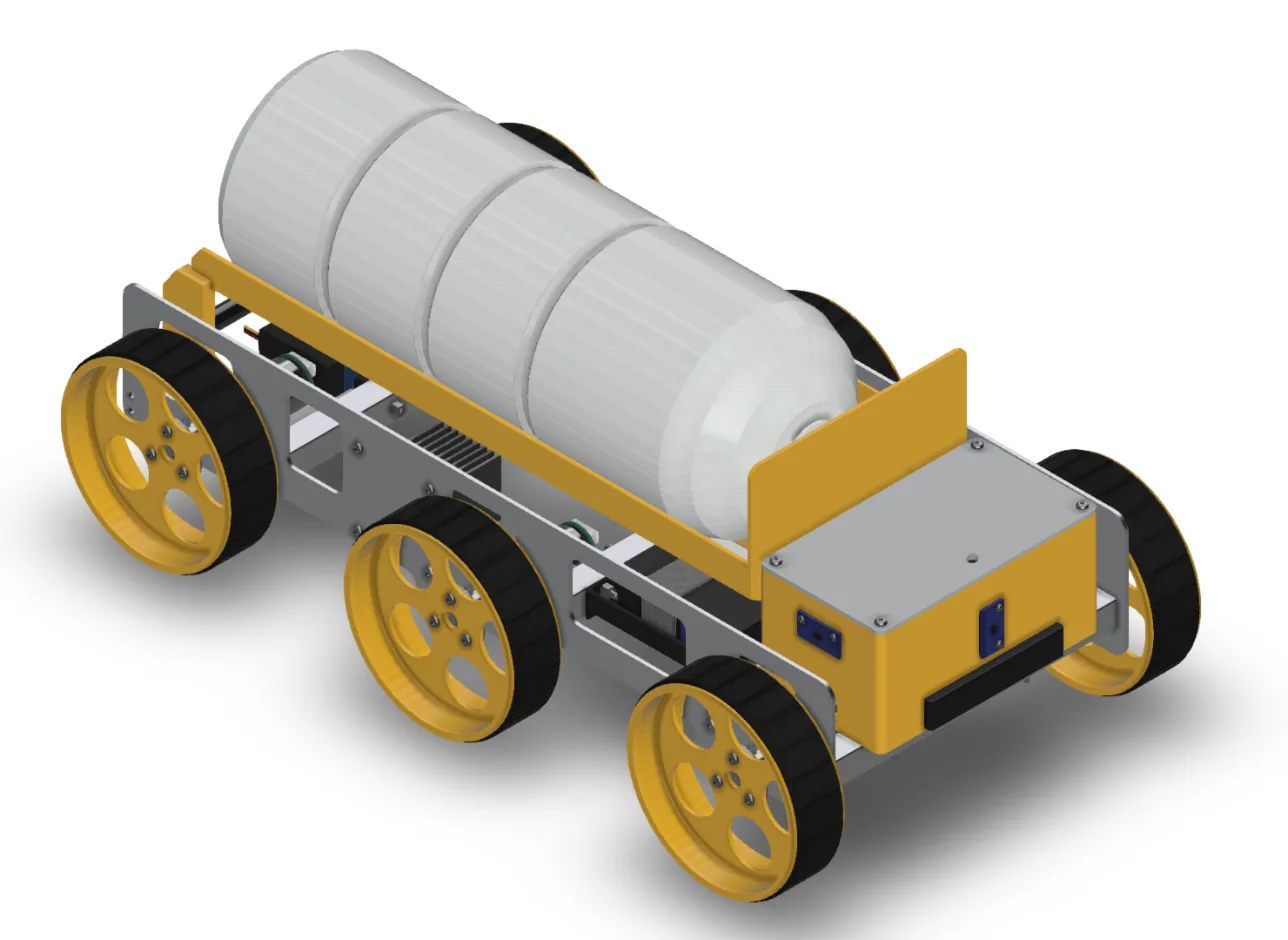
CAD model of the six-wheel dump truck with its bed tipped
Competition at the end of November 2026

Six-wheel RC dump truck

A six-wheel, skid-steer truck that carries 2 kg, crosses 15 cm gaps and climbs a 45° ramp. Motors and dump-bed hinge sized by torque and center-of-gravity calculations in a parametric Fusion 360 model.

305
components in the CAD assembly
445 × 244 mm
inside a 450 × 250 mm limit
6
independently driven wheels
Read the case study

Experience

Industry, research and leadership

January 2026
Bruchsal, Germany

VMT GmbH, Herrenknecht Group

Automation and navigation systems intern

  • Set up and calibrated the navigation and automation systems that steer tunnel boring machines on tunneling projects worldwide: total stations, laser targets, gyroscopic systems and guidance software.
  • Learned TBM control and navigation from operators in the TBM control cabin and the surface navigation control room. Went underground into live tunnels and joined site meetings with managers, engineers, contractors and commercial teams.
  • Independently developed a business development roadmap for the Middle East, analyzing regional business culture, economic structures and political systems, and presented it to VMT's Managing Director, Head of Sales and Regional Sales Manager.
Inside a tunnel under construction, on a site visit
Launch shaft of a tunneling machine
Control cabin of a tunneling machine
Calibration lab for navigation sensors
Test setup with coded reference markers

June to December 2025
Portland, Maine (worked remotely)

Born Global Foundation

Research intern

  • One of two students selected through a competitive application and interview process.
  • Researched biomimetic coatings for solar panels, mentored by a U.S. Department of Energy Fellow.
  • Conducted a literature review and meta-analysis of diatom-inspired solar coatings that boost absorption and limit overheating.

I founded the largest student society in the history of AUB: 1,877 scholars.

Induction ceremony for new members, with 80% of members attending
Entrepreneurship event with a live investor discussion
Recording the podcast, the first produced by an AUB society
Ambassadors presenting at a high school

April 2025 to present

AUB Honor Society

Founding president

  • Founded the society to unite 1,877 scholarship recipients, with a mission to recognize their talent and give them the resources, network and opportunities to excel.
  • Manage a $40K budget and launched a scholarship program funded by the society, with the Office of Financial Aid.
  • Launched AUB's first student-led ambassador programs: 50 ambassadors attracting top high-school students in Lebanon and abroad.
  • Created AUB's first society-run podcast.
  • Lead scholar recognition, alumni engagement, events (80% average attendance at the annual induction ceremony), a newsletter and volunteering.

October 2022 to May 2026

Harvard MUN, AUBMUNC and LAUMUN

Chair and award-winning delegate

Diplomatic Commendation, Harvard MUN 2024
  • Chaired the General Assembly Sixth Committee at AUBMUNC 2026 on liability for AI in decision-making systems.
  • Diplomatic Commendation at Harvard MUN 2024, among 4,000+ delegates. First place at LAUMUN 2023, among 1,000+.
  • Later trained 16 students in public speaking, policy writing, research and UN rules of procedure.

About

Education and skills

Portrait of Ghady Sader

I'm a mechanical engineering student at UC Berkeley and the American University of Beirut, where I hold one of only 10 Full Merit Scholarships that AUB awarded among its 6,400+ applicants in 2024. It covers 100% of tuition.

Most of my projects end in a competition or a physical test, and I usually lead the team. Outside engineering, I founded and run the AUB Honor Society.

Degree
Bachelor of Engineering in Mechanical Engineering, UC Berkeley and AUB, August 2024 to June 2028
Academic record
GPA above 4.0 of 4.0. Dean's Honor List every semester since enrollment.
CAD and simulation
SolidWorks (Simulation, Motion), ANSYS (structural and thermal FEA), Fusion 360
Programming and analysis
MATLAB, Simulink, Python, LabVIEW, Arduino
Manufacturing
Lathe, milling, 3D printing (FDM), sheet metal forming, casting, soldering, mechanical assembly
Testing
Data acquisition (NI DAQ), strain gauges, load cells, oscilloscope, multimeter, motor control, materials testing (tensile, impact, fatigue, hardness)
Before university
Valedictorian with Highest Distinction, Jesus and Mary School, Rabweh, Lebanon. SAT 1560 of 1600 on the first attempt. 2024 AUB Mathematics Olympiad finalist. Won the school-wide multidisciplinary project competition with a functional Hyperloop prototype.
Languages
Fluent in English, French and Arabic
Looking for a summer 2027 internship.

gsader@berkeley.edu
LinkedIn
Ghady Sader, Berkeley, CaliforniaUpdated November 2026
All work

1st placeFEA Structural Optimization Competition, among all AUB teams

FEA-optimized steel pipe

A 1 mm galvanized-steel pipe, cantilevered from a wall and full of water, redesigned over 49 simulation runs until it ranked first among all AUB teams.

Result
1st place
When
Spring 2026
Course
Mechanics of Materials, AUB
Tools
SolidWorks Simulation
Von Mises stress across the final pipe, highest along the top edge of the web at the wall

Von Mises stress in the final design, peaking at 8.1 MPa. Post-processed from the SolidWorks Simulation results.

The problem

Carry water from an inlet fixed to a wall to a free outlet 2.0 m forward and 0.5 m to the side, through one 90° turn. Keep at least 15 cm² of flow area everywhere and at least 1 mm of wall. The pipe sags under its own weight and 37.5 N of water, and the lowest score wins:

Score = mass (kg) + 0.2 × outlet deflection (mm) + 80 × peak stress (GPa)

49 runs

We logged every run in a tracker and kept a change only if it lowered the score. Move along the chart to see what each version changed and what it did to the score.

Filled points lowered the best score and were kept. Hollow points were rejected. Use the arrow keys to step through versions.

What won

  • A circular section. Rectangular ducts stalled at 5.77 because the side arm twists the main run. A 44 mm tube with a 1 mm wall gives 15.20 cm² of flow with the least perimeter and the best torsional stiffness per gram.
  • A tapered web. A 1 mm plate on top of the 2 m arm, 200 mm tall at the wall and tapering to nothing at the elbow, follows the bending moment. Stiffness grows with the cube of the web's height but only linearly with its thickness.
  • A corner gusset. A 150 × 150 × 1 mm triangle inside the elbow relieves the stress concentration for about 0.09 kg.
Final geometry: tube, tapered web and corner gusset
The web, tallest at the wall

Results

First designFinal designChange
Score10.175.18−49%
Outlet deflection10.76 mm1.11 mm−90%
Peak von Mises stress54.9 MPa8.10 MPa−85%
Mass3.63 kg4.31 kg+19%

The final study used 10,030 second-order tetrahedral elements and 19,888 nodes, with welded bodies under gravity and the water load. Spending 19% more mass on the web and gusset cut deflection and stress far more than it cost.

Displacement, 1.11 mm at the outlet. Deformation drawn at 150×.
Stress at the wall, where the web carries the bending.
All work

Best Project AwardRank 1 among AUB mechanical engineering students

3-point bending test machine

A desktop machine that bends a specimen until it breaks and plots stress against strain while it does. Built for $130.

Result
Best Project Award, rank 1
Course and term
Engineering Materials, AUB, Fall 2025
Role
Team lead, team of 4
Tools
3D printing, Python
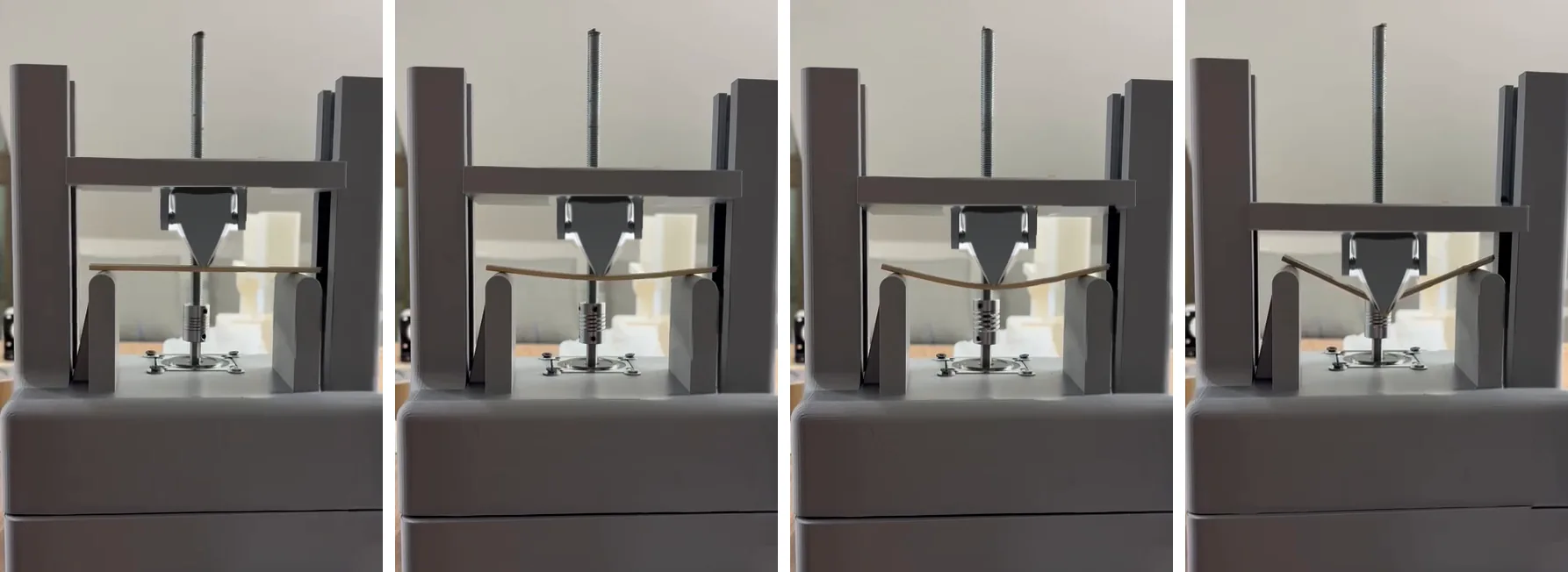
Four frames of one test: the specimen at rest, bending, at maximum load and fractured

One test from start to fracture, taken from the recording.

Why build one

Commercial flexural testers cost thousands of dollars. We set out to build a compact machine that loads a beam at its center until it fails and records force and displacement throughout, at a small fraction of that cost.

How it works

  • Frame. A 3D-printed column and crosshead structure on an enclosed base, with two specimen supports and a wedge-shaped loading nose.
  • Drive. A stepper motor in the base turns a threaded rod through a flexible coupler and moves the crosshead.
  • Software. Custom Python software handles motor control and real-time force-displacement acquisition. It jogs the crosshead at a set speed, zeroes the reading, starts a test with one click, plots the data live and exports it as CSV. A specimen-shape setting lets it convert force to stress.
A full test, from first contact to fracture
The control software

Result

The machine runs a full test to fracture and produces the curve below on its own software: stress climbs to about 100 MPa and the specimen breaks at about 2.9% strain.

It won the Best Project Award. The professor adopted the design as the model for future cohorts and proposed developing it further for installation in AUB labs.

Stress against strain, as plotted by the machine
All work

CoreXY desktop 3D printer

The complete mechanical hardware of a desktop printer: frame, motion system, bed and electronics bay, designed for a stiffness and precision competition.

Status
Design frozen, competition in December 2026
When
Fall 2026
Team
4 people, Mechanical Design I, AUB
Tools
SolidWorks, ANSYS, Python
CAD model of the printer: aluminum extrusion frame, CoreXY gantry, bed on three lead screws and an electronics bay

CAD model at the preliminary design stage. The frozen design replaces the X beam with a 20 × 20 × 2 mm tube.

Choosing the architecture

Four layouts were sized for the same 180 mm cube and 5,000 mm/s² acceleration, then scored on nine weighted criteria. CoreXY with a Z-moving bed scored 3.85 of 5, ahead of a fixed-gantry Cartesian at 3.65. It has the lightest moving mass, 0.73 kg, and keeps both motors on the frame.

To check that the result did not depend on our choice of weights, we ran 20,000 Monte Carlo trials with randomized weights. CoreXY stayed first in 94.3% of them, and in 67.6% when the scores were randomized as well.

The four concepts, to scale
The two CoreXY belt loops, stacked rather than crossed

The beam was twisting

The nozzle hangs 115 mm below the X beam, so a sideways push at the nozzle twists the beam as well as bending it. The preliminary calculation counted only bending and predicted 7.2 µm. FEA in ANSYS gave 52.1 µm, and a hand calculation with torsion included showed twist was 92% of it.

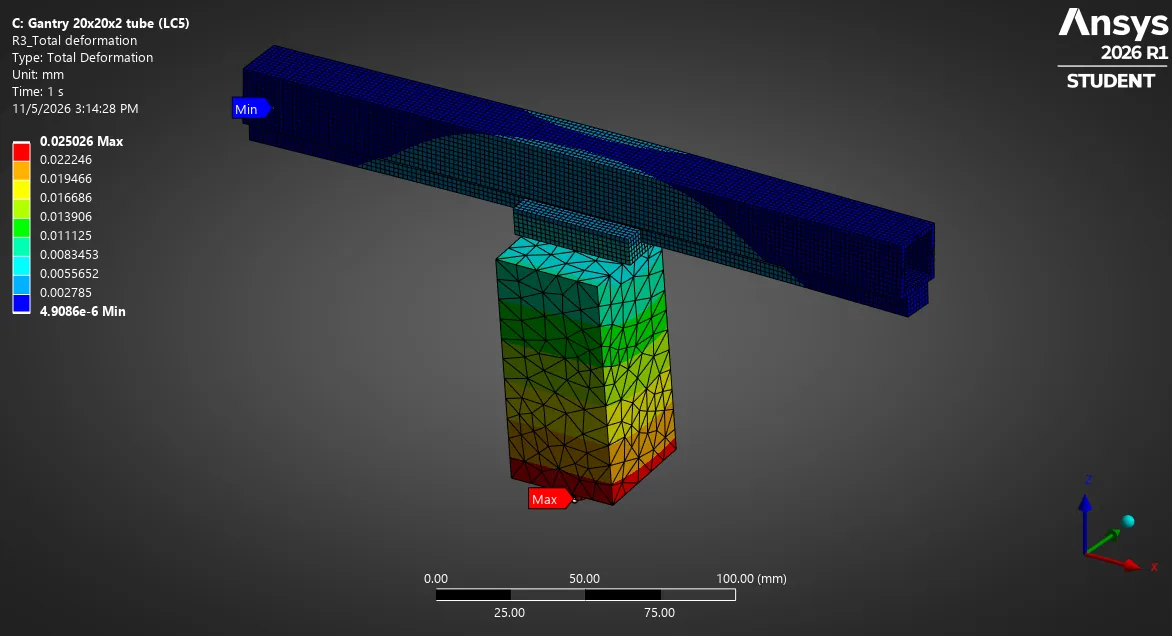
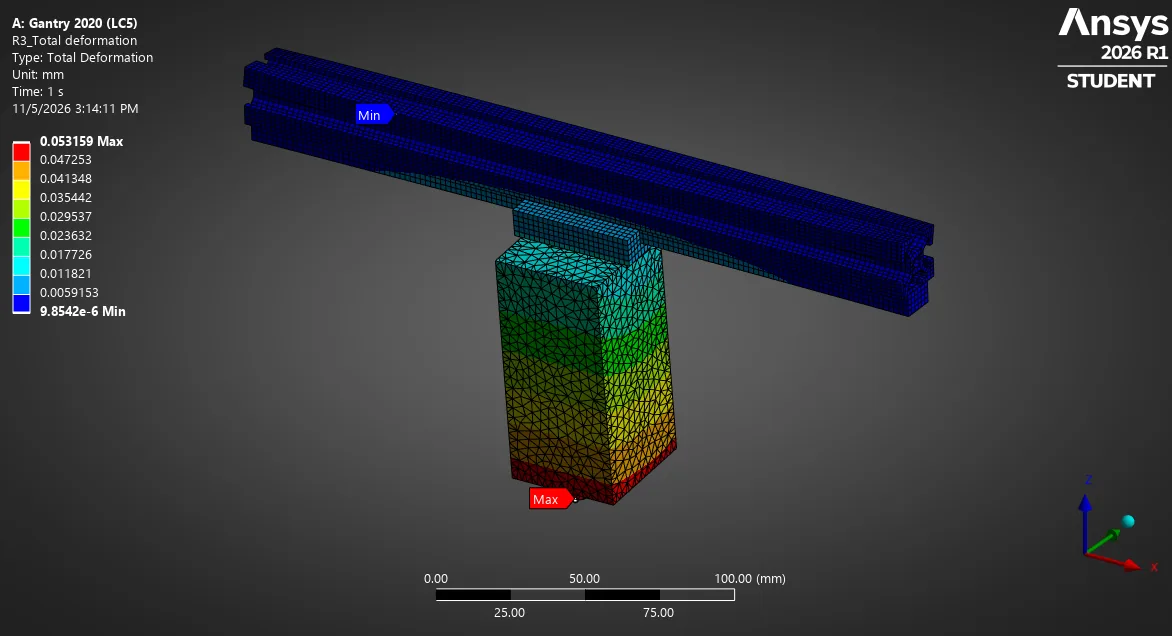
A 20 × 20 × 2 mm square tube has the same outer size as the original extrusion, so nothing else had to change. It cut the beam's deflection by 53% and it weighs less: 0.10 kg against 0.13 kg. Drag the handle to compare.

ANSYS deformation plot of the tube beam, 24.6 micrometres at the nozzle ANSYS deformation plot of the original extrusion beam, 52.1 micrometres at the nozzle Extrusion, 52.1 µmTube, 24.6 µm

Total deformation under a 10 N load at the nozzle, ANSYS Workbench. Mesh refined to 86,000 nodes.

Shaft fatigue

The belt pulls each motor pulley in a fixed direction while its shaft turns, so every revolution fully reverses the bending stress. One shaft carried its pulley 40.5 mm out from the bearing, and a Shigley fatigue analysis gave it a safety factor of 1.74.

A 14 mm spacer under that motor shortens the overhang to 26.5 mm and raises the safety factor to 2.66. ANSYS agrees: 1.80 before, 2.78 after.

The design

  • Frame. 2020 aluminum extrusion, 19 pieces, with blind tapped joints. Designed travel is 206 × 182 × 185 mm at an estimated 8.7 kg.
  • Motion. CoreXY with 9 mm belts, linear rails on every axis.
  • Bed. A 200 × 200 × 6 mm cast aluminum plate on three lead screws, synchronized by one belt to a single hand crank that needs 0.86 N at the knob and holds position by itself.
  • Electronics bay. Room, ventilation and cable routing for a power supply and controller board.
Exploded view
Gantry and carriage
Bay and Z drive

Where it stands

The table compares the targets we set with the frozen design. These are design values, and two targets are not met yet.

TargetFrozen design
Travel≥ 180 mm cube206 × 182 × 185 mm
Mass≤ 9 kg8.7 kg
Parts cost≤ $450$446 midpoint
Nozzle deflection at 10 N≤ 50 µm85 µm
Footprint≤ 350 × 350 mm406 × 366 mm

Belt stretch is now the largest part of the nozzle deflection, so that is the next thing to improve.

Measured stiffness, backlash and alignment, and the competition result, will be added after the build in December 2026.

All work

2nd placeMicro-Car Competition, among AUB mechanical engineering teams

Off-road micro-car

A four-wheel-drive contest car that runs on one motor. It finished second among AUB mechanical engineering teams.

Result
2nd place
When
Fall 2026
Role
Design and manufacturing lead, team of 4
Course
Manufacturing Processes I lab, AUB
The micro-car: plywood chassis, DC gear motor, battery under a steel strap and four off-road tires

The contest

Four events decide the ranking: a sprint, an obstacle course, a 30° ramp climb and a tug of war. Speed matters in the sprint and torque matters on the ramp and in the tug of war, so the gear ratio had to balance the two.

Full ramp climb to the top, at 2.5× speed
Tug of war

One motor, two belts

A single DC gear motor drives the first axle through a timing belt with a 3:1 reduction, which gives up some speed for the torque needed on the ramp and in the tug of war. A second belt under the chassis ties the two axles together, so all four wheels are driven and the car keeps pulling when one axle is in the air over a pipe.

We made the parts ourselves: lathe-turned steel shafts, a milled baseplate, bearing holders, motor and battery mounts, fused wiring and the belt drive. Each axle runs in ball bearings pressed into its holders under the baseplate.

Motor to axle, 3:1
Axle to axle, under the chassis
Layout from above
All work

Six-wheel RC dump truck

A six-wheel, skid-steer truck designed and manufactured to haul 2 kg, tip it onto a target, cross 15 cm gaps and climb a 45° ramp.

Status
Competition at the end of November 2026
When
Fall 2026
Course
Manufacturing Processes I, AUB
Tools
Fusion 360
CAD model of the six-wheel dump truck

Fusion 360 model, 305 components. In the tipping views the bed is posed at 38° about its hinge.

The brief

  • Fit within 450 × 250 mm. The model measures 445 × 244 mm and stands 193 mm tall.
  • Carry a 2 kg payload, tip it onto a floor target and bring the bed back.
  • Drive a T-shaped track and cross table gaps of 5, 10 and 15 cm.
  • Earn bonuses for climbing a 45° ramp and for the tightest turn, and score on payload per kilogram of truck.

Design

  • Six driven wheels. Identical drive modules, each a 12 V, 169 rpm gear motor on a 104 mm wheel. With three axles the truck always has two on the table while the third crosses a gap.
  • Skid steering. The truck turns in place like a tank to take the turn-radius bonus. The middle axle sits about 2 mm lower so the outer tires scrub less.
  • Geared tipping bed. A 35 kg·cm servo drives a 14-tooth pinion against a 42-tooth sector gear on the bed, tripling its torque. The bed pivots on a 6 mm pin in bronze bushings, and a limit switch reports when it is back down.
  • Electronics. An ESP32 controller with a radio receiver, two motor drivers, a fused 3S battery, an inertial sensor and four distance sensors, in a sealed cabinet.

Analysis

The model is parametric: one shared set of equations holds the measured bottle and motor dimensions and updates every part. Motor torque on the ramp, hinge torque for tipping at about 4 N·m, and the center of gravity were all sized by hand. The empty truck balances over its middle axle so it can reach across a gap.

Reconciling two competing blueprints before the build caught 10 engineering issues on paper, so the final truck was built with no major redesigns.

Build photos, test video and the result will be added after the competition at the end of November 2026.